Picking the Right Porn Chat AI Character for the Mood
Mood and genre are different axes, and most disappointing character choices come from filtering on the wrong one. A reader who wants a slow, quiet exchange will not be helped by a tag list that only describes setting, and a reader in a playful mood is not looking for a long narrative arc. Mapping three or four mood words onto the tags that actually carry them takes about twenty minutes, once.

Key takeaways
- Describe the mood in your own words first, then find the card tag that comes closest to it.
- Two conditions are enough: one mood-shaped tag plus the content state, such as Unfiltered.
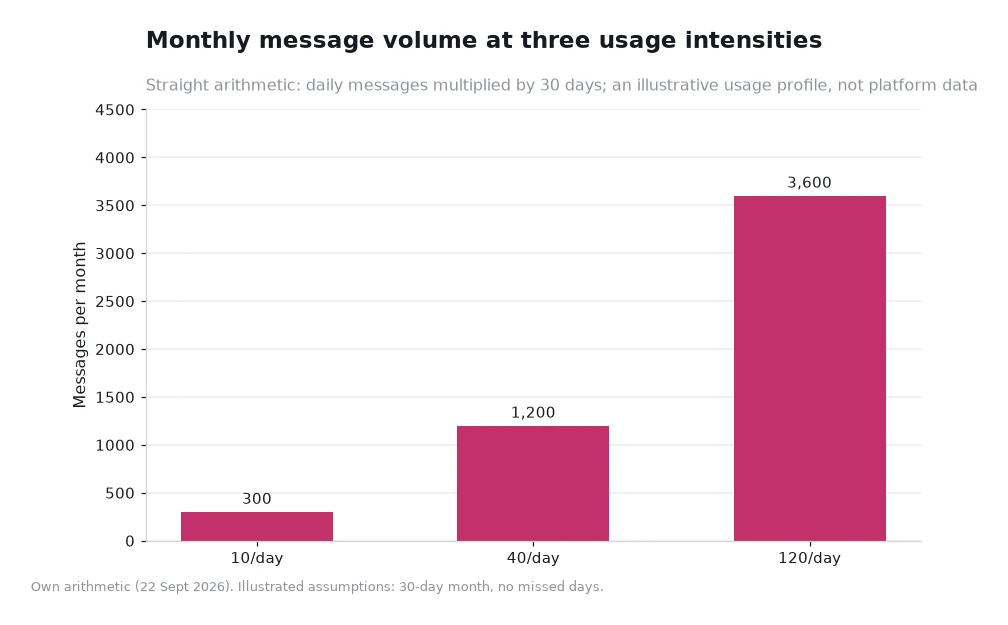
- Short sessions suit playful moods, long sessions suit narrative ones; 3,600 messages a month is 120 a day, and that pace is spent quickly on long arcs.
- Keep a mood map of three or four entries rather than chasing the whole tag list.
Why mood and genre disagree
A genre describes a setting, and a mood describes an energy. The two are independent: the same setting can support a quiet conversation or a sharp one, and the same mood can appear in a dozen different genres. Tag lists on character cards lean towards genre and behaviour, which is why a search driven only by tags can return characters that are correct and still feel wrong.
Mood words are easier to feel than to define, but they are not vague. Pace is part of it - slow, unhurried, brisk. Temperature is another - warm, playful, cool, sharp. Structure is a third: does the exchange drift, or does it move somewhere. Naming those three axes for yourself is enough to turn a feeling into a decision.
Then match against what cards actually offer. Labels such as Submissive describe interaction style, Fictional and OC describe provenance, Female describes the character, and the Filtered, Unfiltered and 18+ states describe content. A mood-shaped label is the one that speaks to how the exchange feels, and it is usually the second condition in a query.
Building a two-column mood map
The method is deliberately small. On the left, write four to six mood phrases you recognise in yourself, in ordinary words rather than platform terms: 'slow and attentive', 'light and teasing', 'dramatic and driven', 'quiet company'. On the right, next to each, write the card label that comes closest after a short browse.
Refine the right column rather than expanding it. After two or three sessions you will notice that one phrase reliably leads to a card you enjoy and another never does, and that is the map doing its job. A map of four honest entries beats a list of forty copied tags, because you will still be able to read it next month.
Session length belongs on the map too. A light, teasing mood survives a ten-minute session and dies in a forty-minute one; a narrative mood needs the longer arc to arrive anywhere. Deciding the length before opening a thread prevents the most common mismatch, which is a good character used at the wrong scale.
Test the map cheaply rather than perfectly. Run one mood phrase for three sessions at the length you noted, then run the same phrase once at double that length and compare. If the shorter version reads better every time, the mood genuinely wants short sessions and the map should say so; if the longer one wins, the label was a narrative mood wearing lighter clothes and the correction belongs on the page. Two weeks of that sort of testing leaves a map with four reliable entries, which is more than most readers ever assemble, and it costs nothing but attention.
Reading the map back is the last step. If a mood phrase has no reliable partner after a fortnight, delete it rather than keeping a hopeful line on the page. A five-line map you trust beats a fifteen-line map you ignore.
| Mood phrase | Tag that carries it | Session length that suits it | Common mismatch |
|---|---|---|---|
| Slow and attentive | A submissive-labelled interaction style | Longer, 20 to 40 minutes | Rushing the opening two messages |
| Light and teasing | Playful behaviour labels on the card | Short, under 15 minutes | Forcing a plot onto a light mood |
| Dramatic and driven | A fiction status such as Fictional | Medium, 25 minutes upwards | Changing direction every few messages |
| Quiet company | An original character (OC) with a calm summary line | Flexible, often short | Expecting an arc from a companion character |
| Unrestricted | The Unfiltered content state | Whatever the mood above needs | Treating a content state as a personality |
The last row is the one people get wrong most often. A content state is not a character trait, and choosing Unfiltered does not tell you anything about pace or warmth. It is the setting, not the mood.
Worked example: what a month of sessions costs in messages
Put a number on the habit before deciding how carefully to choose. Using a 30-day month as an illustrative assumption, 10 messages a day is 300 messages a month, 40 a day is 1,200, and 120 a day is 3,600. If a session runs about 60 messages, those three paces imply 5, 20 and 60 sessions a month respectively, because 300 divided by 60 is 5, 1,200 divided by 60 is 20 and 3,600 divided by 60 is 60.
Now attach a session length. At 12 minutes each, 60 sessions a month is 720 minutes, or 12 hours; at 12 minutes each, 5 sessions is 60 minutes, or one hour. The first reader can afford to experiment and still find a mood; the second cannot, which is the argument for building the map before the month starts rather than in the middle of it.
Using the map with the catalogue
Once the left column exists, the search becomes mechanical: pick the mood phrase, use the tag beside it as the second condition, and let the front of the results give you two candidates. Readers who would rather keep the whole set of options visible will find the platform's own trending list a reasonable place to check the right column weekly.
Save what works and note the mood phrase beside it. After a month the map is less a theory and more a set of three or four reliable pairings, and the question 'what do I feel like tonight' stops being a browse of the whole porn ai chat catalogue, because the answer is already written down. When a mood phrase still has no partner after a fortnight of testing, the platform's character search usually settles it in one query: stack the closest label with the content state you prefer, and check whether the first three cards belong to the mood you meant.
Frequently asked questions
How many tags should a mood query use?
Two: the mood-shaped label and the content state. A third condition narrows the result so far that the mood itself stops being visible in the cards you see.
Should I pick a character or a mood first?
Mood first. It decides session length and the tag you search with, and it usually excludes most of the catalogue before you compare any two cards.
What if no tag matches the mood I have in mind?
Choose the closest tag and adjust the opening message instead. Pace and warmth can be set by how you start, and the choice of content state handles the rest.
Write the map, then use it
Spend twenty minutes once on four mood phrases and their labels, add a session length to each, and keep the notes where you will see them. Then run one session at the right length for the mood you actually have, rather than opening a thread and hoping the shape of the evening reveals itself.
Sources: tag examples, the Filtered, Unfiltered and 18+ states and the card counters referenced above were read from Crushon on 22 Sept 2026. Message and session totals are illustrative arithmetic rather than platform data.[1] Published for adults aged 18 and over.